
How to Choose a Hospital Management System in East Africa
If you are a hospital director, clinic administrator, or healthcare IT manager in Uganda or East Africa, you have probably already felt the pain of running a health facility on paper registers, WhatsApp messages, and disconnected spreadsheets. You know a Hospital Management System (HMS) is the answer — but with dozens of options available, from international platforms to locally built systems, choosing the right one is harder than it looks.
This guide will walk you through exactly what to look for, what questions to ask, and what mistakes to avoid — so you can choose an HMS that actually works for your facility, your team, and your budget.
🏥 Already know what you need?
PearlCare is a hospital management system built specifically for clinics and hospitals in Uganda and East Africa. See PearlCare HMS →
What is a Hospital Management System?
A Hospital Management System is software that connects every department of a health facility into one platform — patient registration, clinical records, pharmacy, laboratory, ward management, billing, and reporting — so that information flows automatically between departments instead of being copied manually from one register to another.
When a patient walks in, registers at reception, sees a doctor, gets a prescription sent to pharmacy, has a lab test ordered, and leaves with an itemised bill — all of that should happen in one connected system. That is what an HMS does.
Without one, the same information gets written in four different registers by four different people, and none of them can see what the others recorded.
Why the Choice Matters More in East Africa
Choosing an HMS in Uganda or East Africa is different from choosing one in Europe or North America. The operating environment here has specific realities that most international software was not designed for:
- Unreliable internet connectivity — many facilities experience frequent outages. Your HMS must work offline or on low bandwidth.
- Mobile money payments — patients pay via MTN Mobile Money and Airtel Money, not credit cards. Your billing module must support this.
- Mixed technical literacy — your nurses, pharmacy staff, and receptionists may have varying levels of computer experience. The system must be simple enough for everyone.
- Local support — when something breaks at 8pm on a Thursday, you need to reach a support team in your timezone, not wait for a response from a vendor in India or the US.
- Constrained budgets — pricing designed for European hospitals is rarely appropriate for Ugandan health facilities. You need transparent, locally relevant pricing.
- Insurance and NHIF compatibility — if you process insurance claims, your billing must be able to generate the right documentation.
An HMS that works perfectly in a private hospital in the UK may be completely unsuitable for a health centre in Kampala. Always evaluate software against your actual operating environment, not a demo environment.
The 10 Things to Evaluate When Choosing an HMS
1. Does it cover all the departments you need?
Start by listing every department and workflow you need the system to cover. A common mistake is choosing an HMS based on one impressive feature — usually the dashboard — without checking whether it covers everything else.
The core modules a complete HMS should include:
- Patient registration and unique patient ID management
- Outpatient (OPD) and inpatient (IPD) management
- Clinical records — doctor notes, diagnosis, prescriptions, referrals
- Pharmacy — dispensing linked to prescriptions, stock tracking, reorder alerts
- Laboratory — test requests from doctors, result entry, result delivery to patient file
- Ward management — bed allocation, occupancy, admission and discharge
- Billing — itemised invoices, mobile money, cash, insurance
- Appointments and scheduling
- Reports and dashboard — daily, monthly, annual exports
If a vendor cannot demonstrate all of these working together in a live demo, ask why. Gaps in functionality become operational headaches the moment you go live.
2. Is it built or adapted for East Africa?
There is a significant difference between software built for East Africa and software that has been adapted for East Africa. Built means the developers designed it with Ugandan health facilities in mind from the start — mobile money integration, local insurance formats, Swahili or local language support where needed, offline capability, and pricing appropriate for the local market.
Adapted usually means an international product with a few local features bolted on. Ask your vendor directly: where are your existing clients? If none of them are in East Africa, proceed with caution.
3. Does it work offline or on low bandwidth?
This is non-negotiable for most facilities outside Kampala city centre — and even for many facilities within it. Ask the vendor exactly what happens when the internet goes down. Can staff continue registering patients, dispensing drugs, and billing? Or does the entire system freeze?
A system that requires constant internet connectivity is a liability in the East African healthcare environment. Test this in the demo — disconnect the internet and see what happens.
4. How does it handle billing and payments?
Billing is where most of a facility’s revenue leaks happen. Your HMS billing module should:
- Generate itemised bills automatically from what was actually done — consultations, drugs dispensed, tests ordered, procedures performed
- Accept cash, MTN Mobile Money, Airtel Money, and bank transfer
- Handle insurance billing and generate the documentation insurers require
- Track outstanding balances and credit accounts
- Produce daily, weekly, and monthly revenue reports that match your cash in hand
A billing module that requires staff to manually type in what was done at the end of a patient visit will have gaps. Every item not typed in is revenue lost.
5. What does the pharmacy module actually do?
Pharmacy is one of the highest-value modules in any HMS. A good pharmacy module should:
- Receive prescription requests directly from the doctor’s screen — no paper, no re-typing
- Track stock in real time — every item dispensed reduces the count automatically
- Alert you when stock falls below your reorder threshold
- Prevent dispensing of expired drugs
- Produce consumption reports so you can see which drugs move fastest and plan procurement accordingly
If the pharmacy module requires a separate stock count to know what is in stock, it is not integrated — it is just a dispense recording tool.
6. Who provides support, and how quickly?
Support is often the deciding factor between a system that works for years and one that gets abandoned after six months. Before signing any contract, ask:
- Where is your support team based?
- What are your support hours? (East Africa Time?)
- How do I reach you — phone, WhatsApp, email?
- What is your typical response time for critical issues?
- Do you provide on-site support in Uganda?
- What happens to my data if your company closes?
A vendor who cannot answer these questions clearly is not ready to support a production healthcare system. Patient data and billing continuity are too important to risk on a vendor with no local presence and no clear support SLA.
7. How long does implementation take, and what training is included?
A system that takes six months to implement is not suitable for most Ugandan health facilities. Ask for a realistic implementation timeline and make sure it includes:
- Data migration — transferring existing patient records if applicable
- Staff training for every role — reception, nursing, pharmacy, lab, billing, administration
- A go-live support period where the vendor’s team is available on-site or remotely
- Documentation in a format your staff can actually use
Ask to speak to an existing client who went through implementation with this vendor. Their experience will tell you more than any sales presentation.
8. Is the pricing transparent and locally appropriate?
Pricing for HMS software varies enormously. Some international vendors charge per user per month in US dollars — which can add up to more than your entire IT budget annually. Others charge a one-time implementation fee with a lower annual maintenance cost.
Ask for the full cost of ownership over three years, including:
- Implementation and setup fee
- Annual licence or subscription fee
- Training cost
- Support and maintenance cost
- Cost of adding users or departments as you grow
- Cost of upgrades
A system priced in UGX by a local vendor who understands the local market will almost always be more sustainable than a dollar-denominated subscription from an international provider.
9. How secure is the patient data?
Patient data is sensitive. Your HMS must protect it. Ask your vendor:
- Where is the data stored — on a server in your facility, or in the cloud?
- Who can access the data, and how are access controls managed?
- How often is data backed up?
- What happens if the server crashes or is stolen?
- Is data encrypted in transit and at rest?
Roles and permissions are also a security feature — every staff member should only see what their role requires. Reception should not see billing totals. Pharmacy staff should not see clinical notes from other patients. Make sure the system enforces this properly.
10. Can it grow with your facility?
The HMS you choose today needs to still serve you in five years when you have doubled your patient volume, added two new departments, and opened a second branch. Ask:
- Is there a limit on the number of patients, records, or transactions?
- Can I add new departments or modules without replacing the whole system?
- Can it support multiple branches or facilities under one account?
- Is the vendor actively developing and improving the system?
Red Flags to Watch For
These are warning signs that should make you hesitate before committing:
- No live demo available — if a vendor will only show you screenshots or a recorded video, they may not have a working system ready to deploy
- No existing clients in East Africa — theory and practice are very different in this environment
- Vague support terms — “we will be available” is not an SLA
- Pricing only available after a lengthy sales process — transparent vendors publish at least a starting price or pricing structure
- Requires constant internet — as discussed above, this is a critical limitation in most East African contexts
- No data export capability — you should always be able to export your own data. A vendor who locks you in with no export option owns your data, not you.
- Too cheap to be credible — a fully functional HMS with real support cannot be delivered for a few hundred dollars. If it sounds too cheap, find out what is not included.
Questions to Ask in Your Demo
When you sit down with a vendor for a demo, use this checklist:
- Can you show me a patient going from registration through to discharge and final billing — live, right now?
- What happens when the internet goes down?
- Show me how a prescription gets from the doctor to the pharmacy.
- How does the system handle a patient who cannot pay immediately?
- Show me the monthly revenue report. Can I export it to Excel?
- Who are three of your current clients in Uganda that I can call?
- What is your response time if the system goes down at night?
- How do you handle a system update — will my staff experience downtime?
A confident, credible vendor will answer all of these in the demo without hesitation. Vague answers or postponed demonstrations are a signal to keep looking.
PearlCare HMS — Built for East African Health Facilities
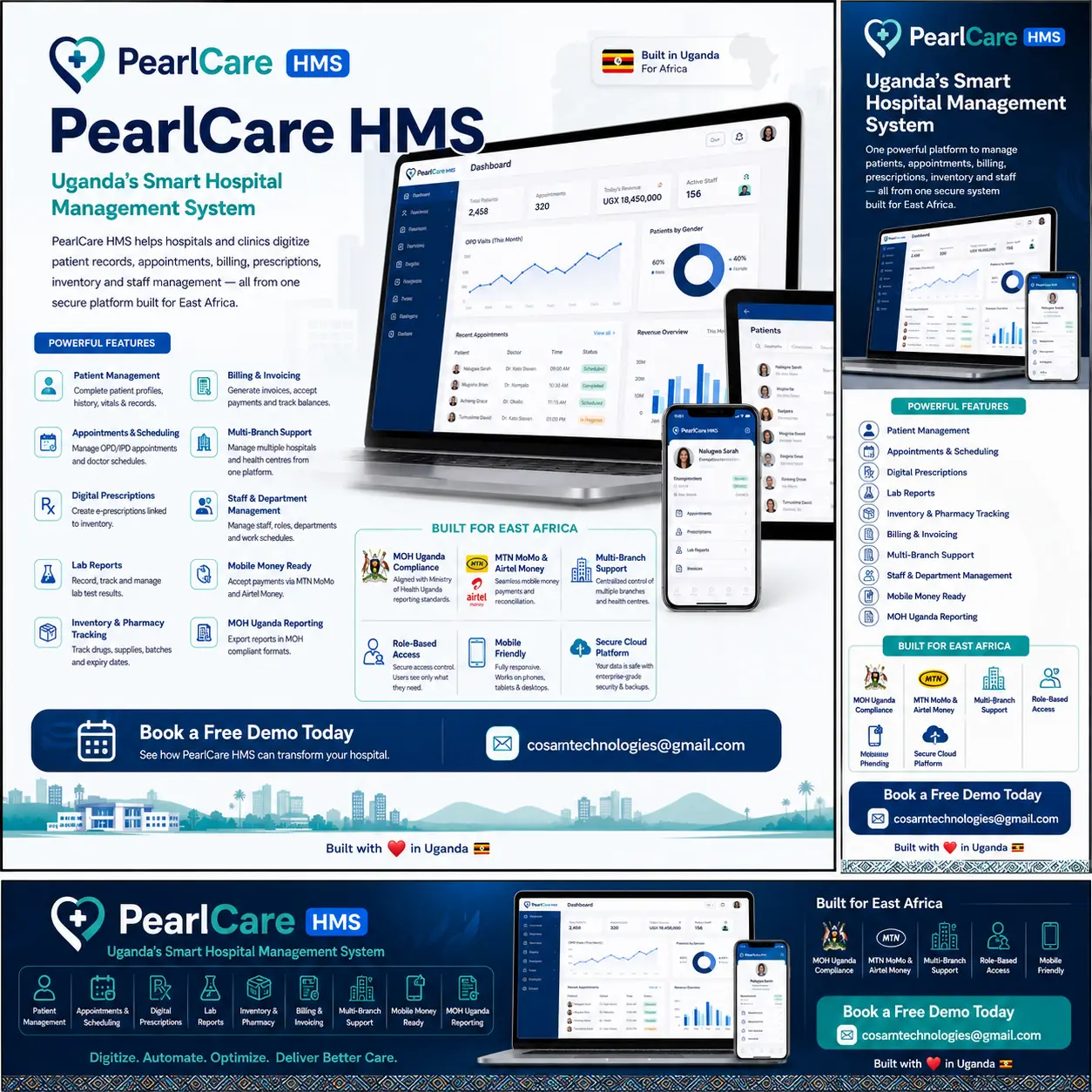
PearlCare is a hospital management system built by Cosarn Technologies, a Ugandan software company based in Kampala. We designed PearlCare specifically for the East African healthcare environment — not adapted from international software, but built from the ground up for how health facilities in Uganda actually operate.
PearlCare covers:
- Patient registration and complete visit history
- OPD and IPD management
- Clinical records — doctor notes, prescriptions, referrals
- Pharmacy — dispensing linked directly to prescriptions, real-time stock, reorder alerts
- Laboratory — test requests and results linked to the patient file
- Ward and bed management
- Billing — cash, MTN Mobile Money, Airtel Money, insurance
- Appointments and scheduling
- Financial reports — daily, monthly, annual, exportable to PDF and Excel
- Roles and permissions per department
Our support team is based in Kampala and is available by phone and WhatsApp. We provide on-site training, go-live support, and ongoing maintenance. Pricing is in Uganda Shillings and is designed for the local market.
See PearlCare in Action
We offer a free live demo tailored to your facility — on-site in Kampala or virtual. Our team will walk you through every module relevant to your departments.
Summary — Your HMS Evaluation Checklist
Before you make a final decision, run through this checklist:
- ☐ Covers all departments I need — OPD, IPD, pharmacy, lab, billing, ward, reports
- ☐ Works offline or on low bandwidth
- ☐ Supports MTN Mobile Money and Airtel Money billing
- ☐ Has existing clients in Uganda or East Africa I can speak to
- ☐ Support team is reachable in East Africa Time
- ☐ Implementation includes staff training for every role
- ☐ Pricing is transparent and includes all costs
- ☐ Patient data is secure with role-based access controls
- ☐ System can scale as my facility grows
- ☐ I have seen a live demo — not screenshots, not a recorded video
Choosing the right hospital management system is one of the most important decisions a health facility makes. Take your time, ask the hard questions, and choose a partner — not just a product.
Have questions about choosing an HMS for your facility? Contact our team at pearlcare@cosarntechnologies.com or call +256 705 129090. We are happy to advise — even if you are not yet ready to make a decision.