
PearlCare HMS: How a Modern Hospital Management System Is Helping Healthcare Facilities Run Smarter
Running a hospital or clinic in Uganda today still means juggling paper registers, disconnected spreadsheets, and manual reconciliation at the end of every month. A patient visits reception, then the consultation room, then the lab, then the pharmacy — and at each stop, staff re-enter information that was already captured somewhere else. Billing happens after the fact, often once the details are already hard to trace. Inventory runs low without warning. Reports that should take minutes take days to assemble by hand.
This fragmentation isn’t just inconvenient — it slows down patient care, creates room for costly errors, and makes it difficult for administrators to know what’s really happening across their facility at any given moment.
PearlCare HMS, developed by Cosarn Technologies, is a hospital management system designed specifically for healthcare facilities in Uganda and East Africa. It’s built to bring reception, clinical care, pharmacy, laboratory, and billing onto a single connected platform — so information is captured once and shared everywhere it’s needed.
See it live
PearlCare HMS is a hospital management system built specifically for clinics and hospitals in Uganda and East Africa. Explore PearlCare HMS →
What Is PearlCare HMS?
PearlCare HMS is a cloud-based hospital management system that supports the full range of healthcare facilities — from small clinics getting off paper for the first time, to multi-department hospitals running both inpatient and outpatient care, to specialist practices like eye and dental clinics. Rather than forcing every facility into the same rigid structure, PearlCare HMS adapts to show only the modules relevant to how a given facility actually works.
At its core, the platform is built around one idea: a patient is registered once, and every department after that — clinical, pharmacy, lab, billing — reads from and writes to that same record in real time.
Why Hospitals Need an Integrated Management System
Healthcare facilities that still rely on manual, paper-based, or disconnected digital processes tend to run into the same recurring challenges:
- Fragmented patient information scattered across registers, department-specific notebooks, and informal handoffs between staff
- Manual, error-prone processes for registering patients, tracking visits, and recording clinical history
- Difficulty tracking patients as they move between departments, especially in busier outpatient (OPD) and inpatient (IPD) settings
- Billing inefficiencies, with invoices generated late, payment statuses unclear, and reconciliation left until month-end
- Inventory and pharmacy stock challenges, where shortages or expired stock are discovered only when it’s too late
- Limited reporting visibility, making it hard for administrators to answer basic questions about revenue, patient volume, or operational performance without days of manual compilation
- Communication gaps between departments, where reception, clinical staff, pharmacy, and billing are effectively working from different, disconnected sources of truth
An integrated hospital management system is designed to close these gaps — not by replacing clinical judgment, but by giving every department a shared, accurate, real-time view of what’s happening across the facility.
Inside PearlCare HMS
1. Centralized Patient Management
At the heart of PearlCare HMS is a searchable, centralized patient registry. Front-desk and clinical staff can look up any patient by name, ID, email, or phone number in seconds, rather than flipping through paper files. Each patient is tagged by visit type — Outpatient (OPD) or Inpatient (IPD) — along with gender, blood group, and current status (such as Active or Admitted), giving staff an immediate operational snapshot without needing to open individual files.
Quick-action shortcuts for registering a new patient, booking an appointment, writing a prescription, recording a lab report, or generating an invoice are available directly from the patient list — reducing the number of steps staff need to take between related tasks.
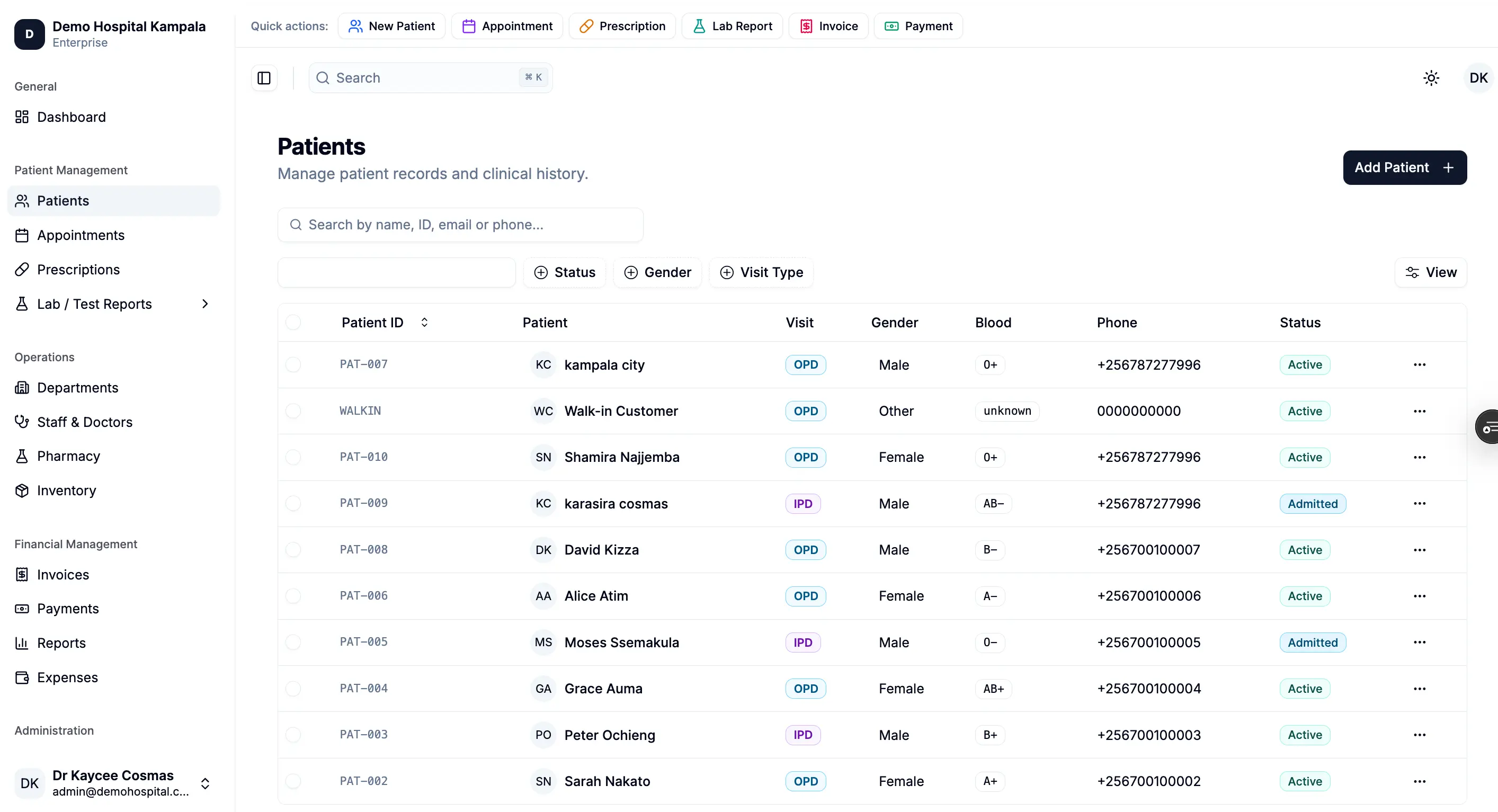
PearlCare HMS’s centralized patient registry, showing searchable records, visit types, and quick-action shortcuts for hospital front-desk teams.
Clicking into an individual patient reveals a consolidated profile: contact details, date of birth, blood group, and a full history spanning appointments, prescriptions, lab reports, invoices, and even specialty records like eye and dental care, all organized in one timeline. This means a doctor seeing a returning patient can review their full history in one place, rather than asking the patient to repeat it or waiting for paper files to be located.
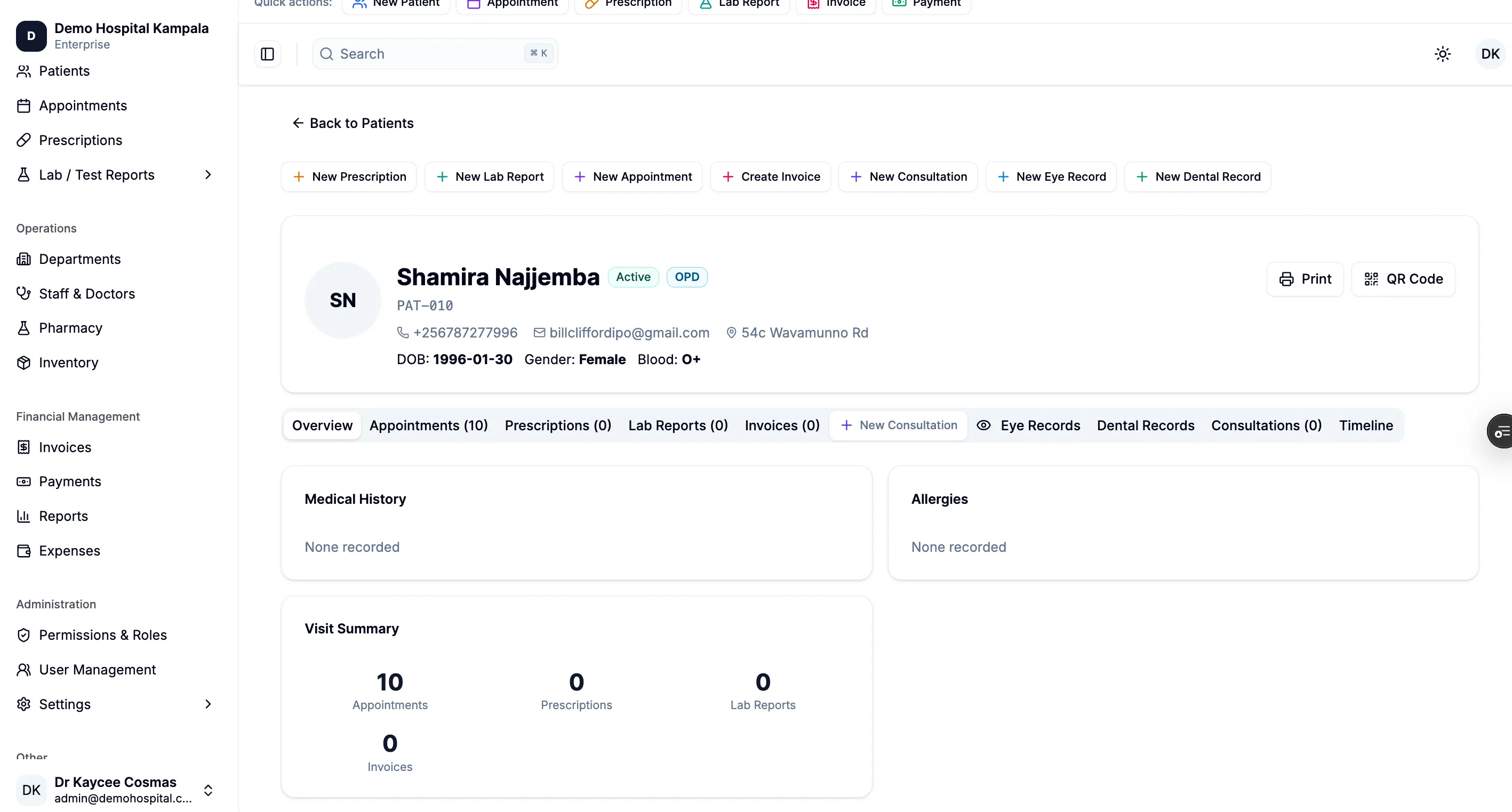
A unified patient record in PearlCare HMS, consolidating appointments, prescriptions, lab reports, and invoices in a single view.
2. Pharmacy Management Connected to Prescriptions
The pharmacy module in PearlCare HMS is directly linked to the prescriptions written by doctors elsewhere in the system. Rather than working from a paper prescription slip that can be misplaced or misread, pharmacy staff see a live dispensing queue showing exactly which prescriptions are pending, who prescribed them, the medication and dosage instructions, and the current status.
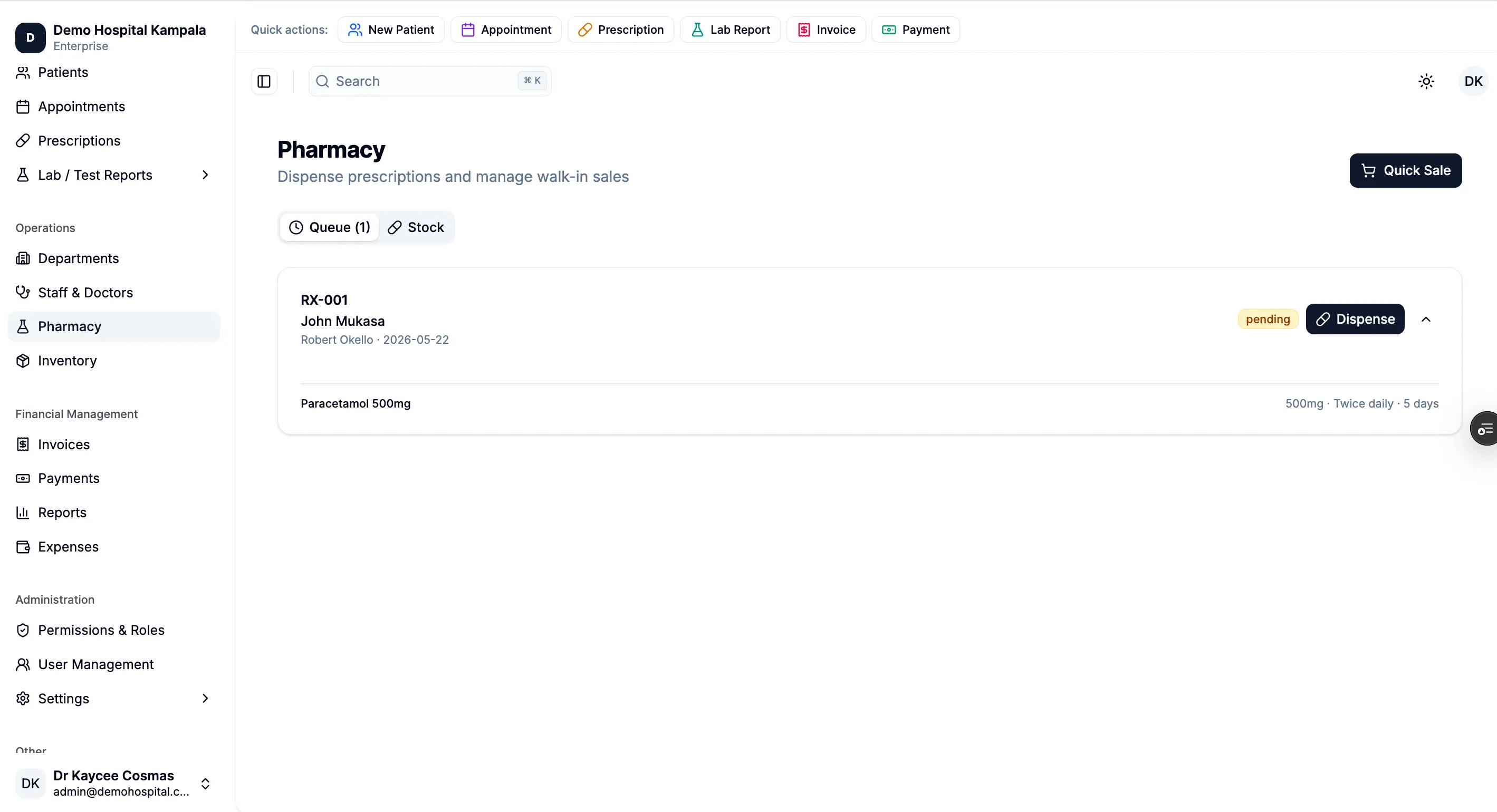
The PearlCare HMS pharmacy module connects prescriptions directly to dispensing, reducing errors and delays for pharmacy staff.
A “Quick Sale” option also supports over-the-counter and walk-in pharmacy sales that fall outside the formal prescription workflow — useful for facilities that also serve as a community pharmacy point. This connection between clinical prescribing and pharmacy dispensing helps reduce medication errors and gives hospital management clearer accountability over what was dispensed, to whom, and when.
3. Inventory Management That Prevents Stockouts
Beyond pharmacy dispensing, PearlCare HMS includes a broader inventory management module covering medications, medical equipment, consumables, supplies, and lab reagents. Each item is tracked with a unique ID, quantity, unit pricing, expiry date where applicable, and supplier information.
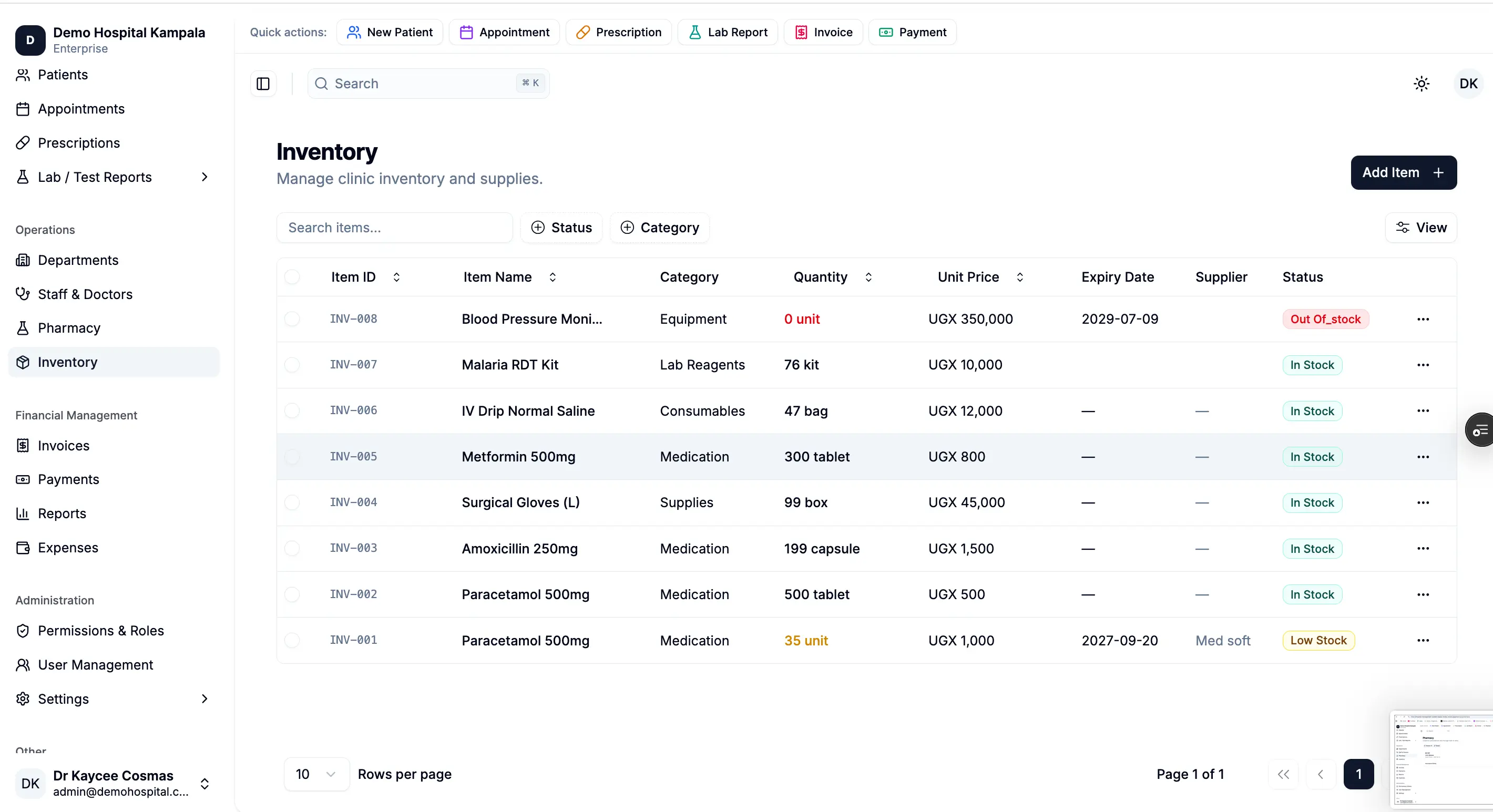
Live inventory tracking in PearlCare HMS automatically flags low and out-of-stock items across medication, equipment, and supplies.
Importantly, the system automatically flags items as In Stock, Low Stock, or Out of Stock — meaning administrators and pharmacy managers don’t have to manually review long paper ledgers to catch a looming shortage. A piece of equipment or medication running low is visible at a glance, supporting proactive reordering rather than reactive scrambling when a critical item runs out.
4. Financial Visibility Through Integrated Reporting
For hospital administrators and finance managers, PearlCare HMS’s reporting module consolidates payments, expenses, profit & loss summaries, invoices, and OPD activity into a single, filterable view. Reports can be generated for custom date ranges — today, this week, this month, the last three months, or all time — and exported directly to Excel or PDF.
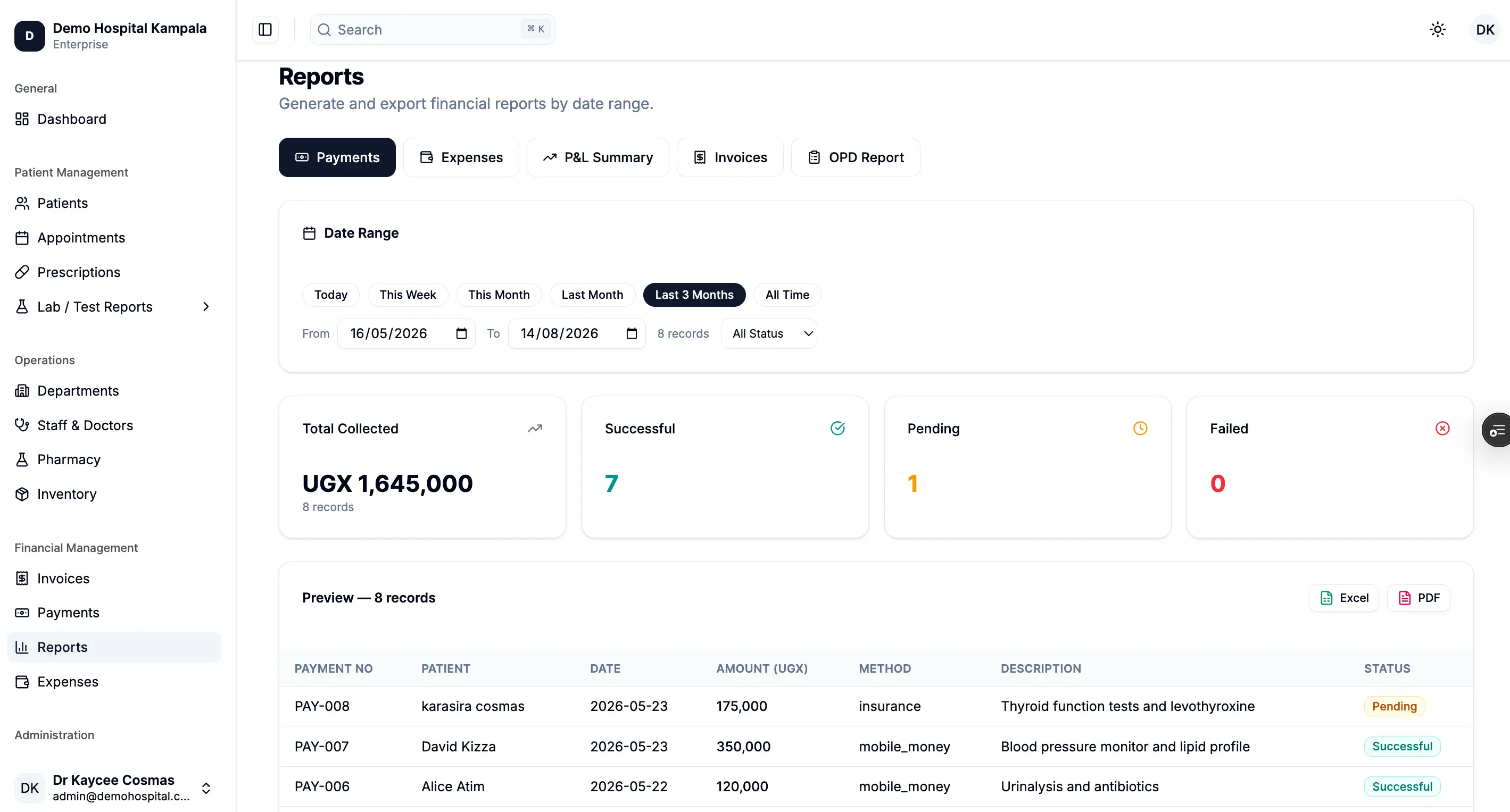
Real-time financial reporting in PearlCare HMS, giving administrators instant visibility into collections, pending payments, and revenue trends.
A summary of total collections, successful payments, pending payments, and failed transactions is presented alongside an itemized ledger showing patient, amount, payment method (including mobile money and insurance), and status. This gives administrators real-time financial visibility instead of waiting until month-end to understand how the facility is performing — supporting faster decisions and more accountable reporting, including for oversight and compliance purposes.
5. Built for Real Hospital Teams
Digitizing a hospital’s operations only works if staff can actually use the system confidently. PearlCare HMS includes a built-in Help Center with role-based guidance covering account access, dashboard navigation, and common workflows — along with defined user roles (Admin, Doctor, Nurse, Receptionist, Lab Technician) so each staff member only sees what’s relevant to their responsibilities.
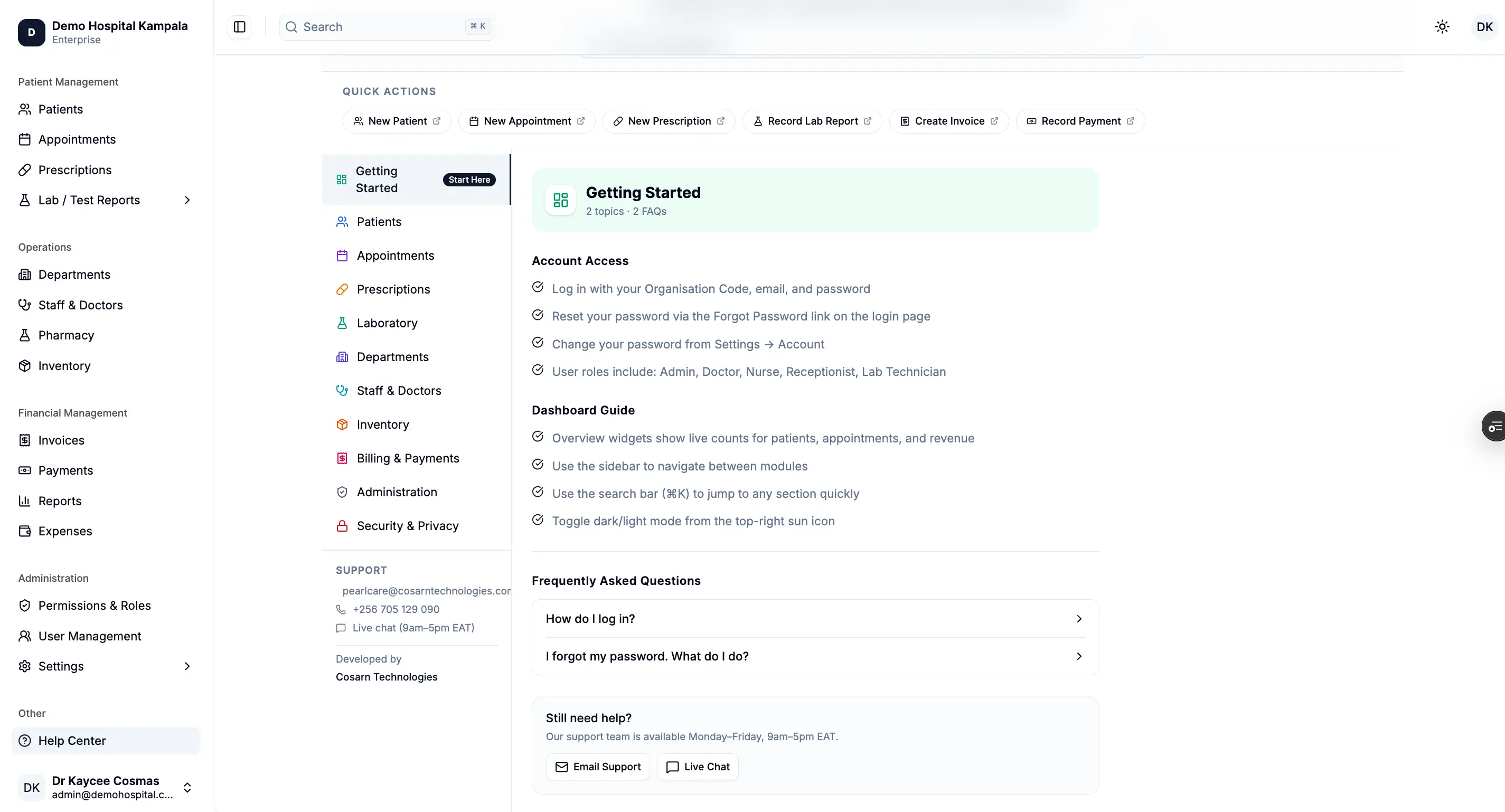
PearlCare HMS’s built-in Help Center supports faster staff onboarding with role-based guidance and direct access to support.
Direct support channels, including live chat and phone support, are also built into the platform, reducing onboarding friction for new staff and cutting down on the kind of “who do I ask” delays that slow adoption of new systems in busy healthcare environments.
A Typical Patient Journey Through PearlCare HMS
To see how these connected modules work together in practice, consider a typical patient visit:
- Registration — The patient is registered once at reception, capturing their demographics and basic history
- Appointment / Visit — The visit is logged as OPD or IPD, and the patient is queued for consultation
- Clinical Consultation — The attending doctor reviews the patient’s existing history directly from their unified profile, without needing paper files or repeated questioning
- Prescription — Any medication prescribed is recorded directly against the patient’s record
- Laboratory — If tests are required, lab orders and results are captured and linked back to the same patient timeline
- Pharmacy — The prescription appears automatically in the pharmacy’s dispensing queue, ready to be fulfilled
- Invoice & Payment — Charges for consultation, tests, and medication are consolidated into an invoice, with payment recorded against it (including mobile money and insurance)
- Reporting — Every step of this journey feeds into the facility’s real-time financial and operational reports, without any manual re-entry
The value here isn’t any single step in isolation — it’s that each department is working from the same connected record, reducing repetition, delay, and the risk of information falling through the cracks between departments.
Digital Transformation Is About More Than Replacing Paper
It’s tempting to think of hospital digitization as simply swapping paper registers for a computer screen. In reality, the more meaningful shift is in how connected the resulting workflows become. When reception, clinical staff, pharmacy, lab, and billing are all working from the same real-time patient record, healthcare teams spend less time chasing information and more time delivering care — while administrators gain the operational and financial visibility they need to run their facility with confidence.
For hospitals, clinics, and health centres across Uganda and East Africa looking to move beyond fragmented, manual processes, PearlCare HMS offers a practical, locally built path toward that kind of connected operation.
Want to see PearlCare HMS in action?
Visit pearlcarehms.com to request a free demo, or get in touch with Cosarn Technologies to discuss how PearlCare HMS can be tailored to your facility.